
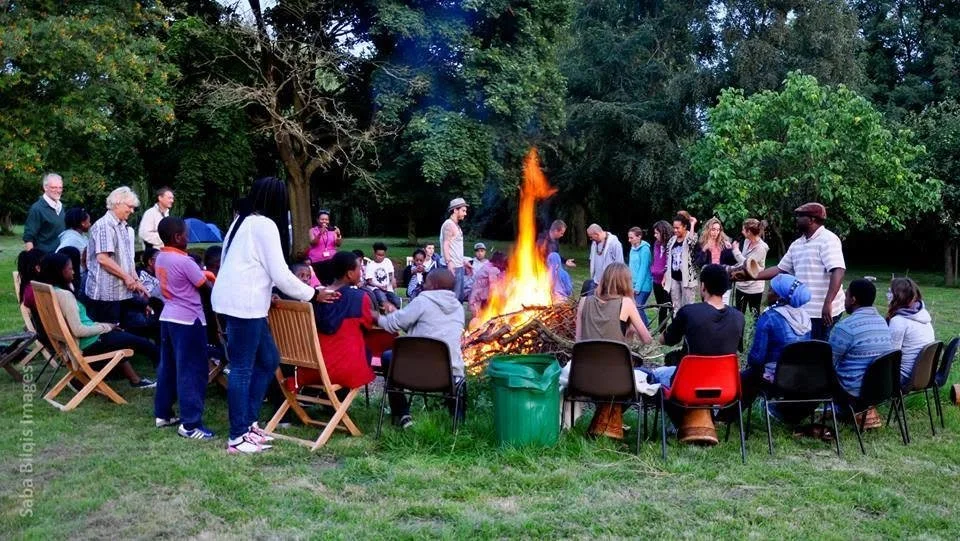
❋
Ubuntu Wellbeing Festival.
What Might Become Possible When Wellbeing is Not Only Discussed—But Encountered?
The Ubuntu Wellbeing Festival invites people to encounter wellbeing as something personal, relational and organisational.
Rather than gathering people primarily as an audience, the Festival creates a living village of story, relationship, movement, reflection, creativity and choice.
People enter as travellers.
They encounter Places designed to invite different forms of reflection and participation. They travel through Wellbeing Walks that bring personal experience into relationship with the people, support and organisational conditions surrounding them.
The Festival does not prescribe what wellbeing should mean to everyone.
It creates conditions in which people and organisations can explore what wellbeing means within the realities they actually inhabit—and what might help them flourish together.
One Village. Three Complete Wellbeing Walks.
The Ubuntu Wellbeing Festival offers three complete Wellbeing Walks.
❋ Tanga Wellbeing Walk
Conscious Recognition and Connection
Tanga—means begin.
Who am I, really?
A Walk beginning with the person: recognising the stories, relationships, terrain, human capacity and support shaping their wellbeing.
❋ Batanai Wellbeing Walk
Shared Participation and Contribution
Batanai—means come together.
Who can we become together, truly?
A Walk carrying personal recognition into relationship: exploring belonging, contribution, interdependence and the communities people create together.
❋ Raramai Wellbeing Walk
Embodied Practice and Sustained Be(coming)
Raramai—means live or be alive.
What can we begin to practise, embody and sustain together?
A Walk bringing recognition and shared possibility into lived practice: exploring what happens when intention encounters real relationships, pressures, power, organisational conditions and everyday terrain.
Enter the Village.

Mauya Conversation Café.
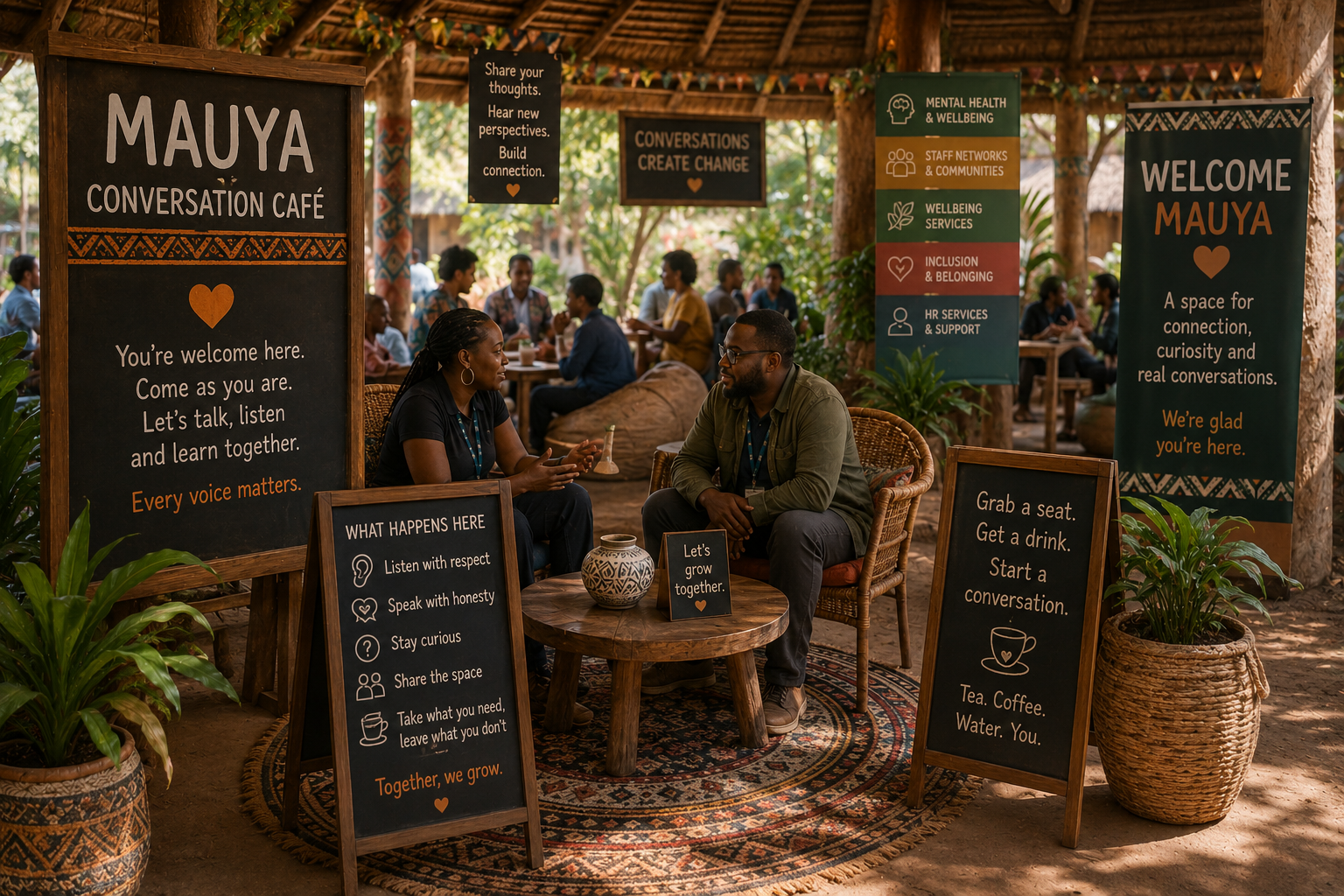
Mauya: The Gateway.
Every Ubuntu Wellbeing Walk begins with the same invitation:
Mauya. Welcome. As You Are.
From Mauya, participants travel through a shared opening pathway:
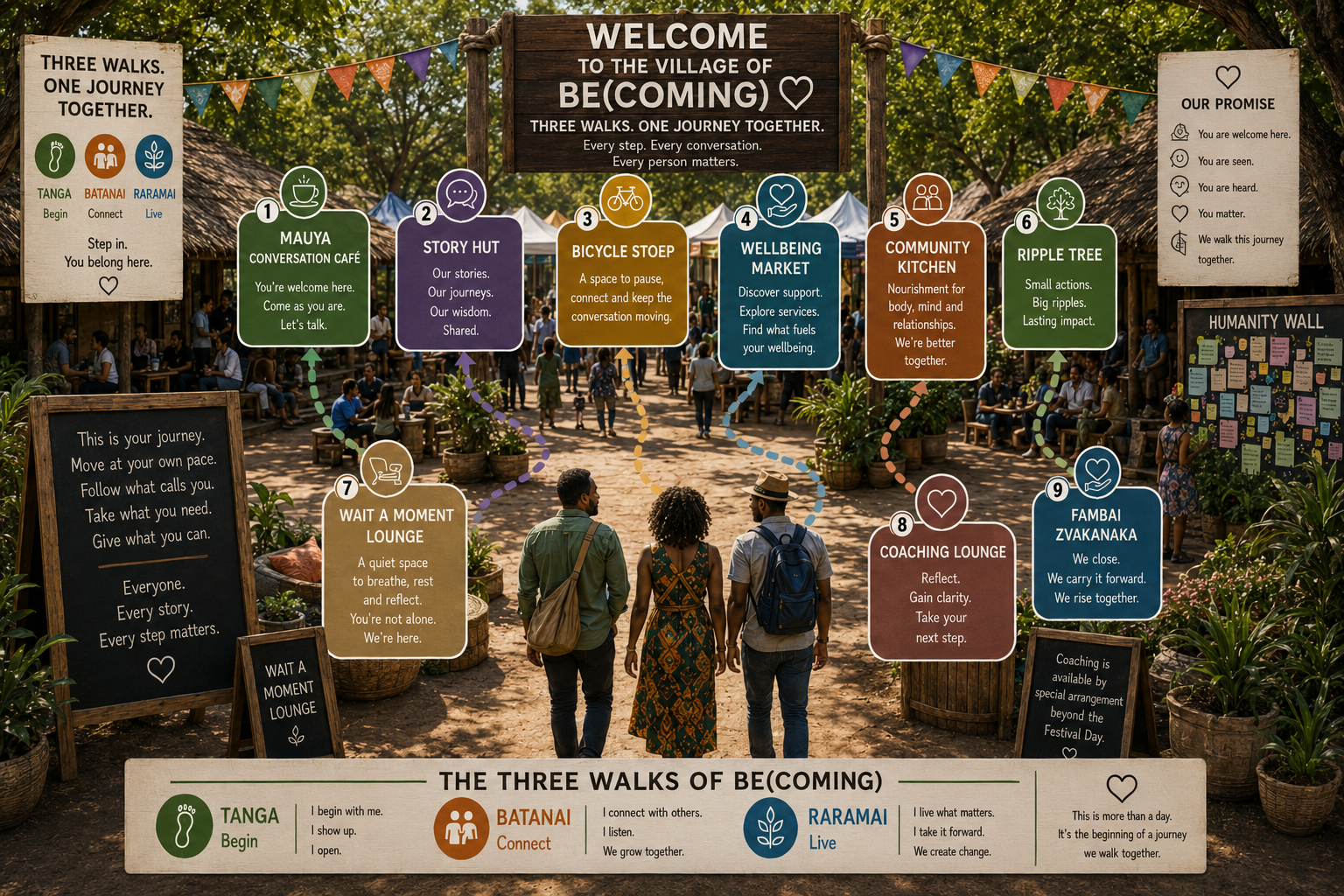
Mauya Conversation Café → Story Hut → Village Bicycle Stoep → Wellbeing Market
The Places are shared. The questions deepen. The relationships widen.
Welcome. As You Are.
Mauya is the gateway into the village — and the Place to which every Wellbeing Walk eventually returns.
Participants are received through hospitality, dignity and informed choice. They enter as whole human beings — not merely as job titles, organisational roles, or recipients of an intervention.
Mauya establishes the spirit in which the Festival is encountered:
Receive hospitality.
Bring intentionality.
Remain open to possibility.
Story Hut.
Exploring and Making Sense of the Stories We Carry.
The Story Hut invites participants to encounter the stories they carry.
Some have been inherited through family, culture or community. Others have been shaped by lived experience, workplaces, relationships and expectations surrounding who people are permitted—or required—to become.
Participants may listen, reflect, speak or allow another person's story to open a question within them.
The Story Hut does not attempt to finish or rewrite anybody's story.
It creates space to recognise that stories can be seen, questioned and related to differently.
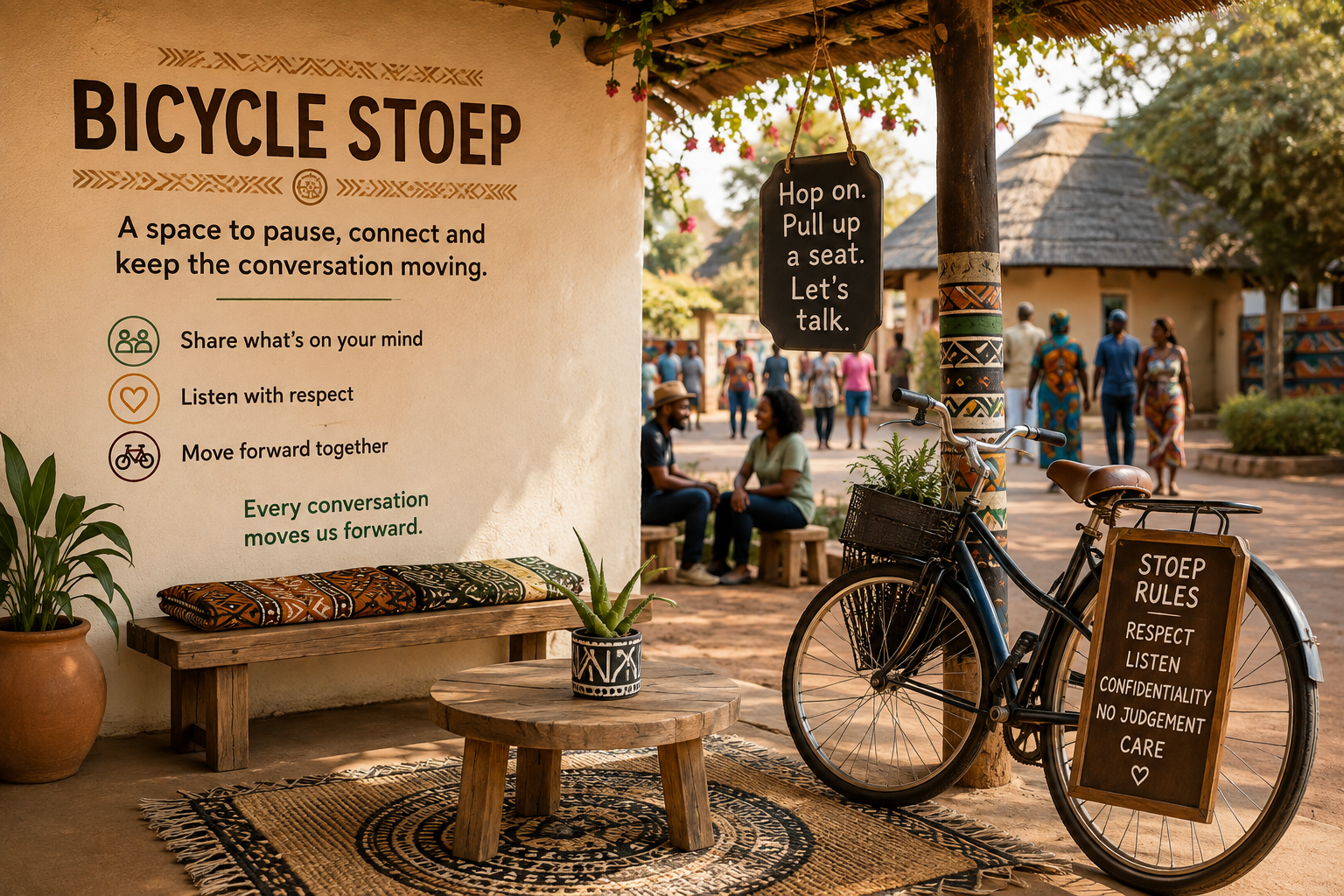
Village Bicycle Stoep.
Waiting on the Village Bicycle Stoep is the Ubuntu Expression Bicycle.
The Bicycle offers a shared language through which each rider can explore and make sense of their own experience of wellbeing—the lived terrain shaping it, the support surrounding their journey and how their finite tokens of time, energy, attention and emotional capacity are being invested along the way.
The Bicycle does not tell people where they should travel. It helps them find language with which to understand and navigate the journey together.
Within Tanga, the Bicycle may help a person recognise their own journey more clearly.
Within Batanai, it can reveal how different journeys intersect and how the ways people travel affect one another.
Within Raramai, it supports participants to explore real terrain, practise new responses and distinguish between personal agency, relational responsibility and organisational conditions.
Wellbeing Market.
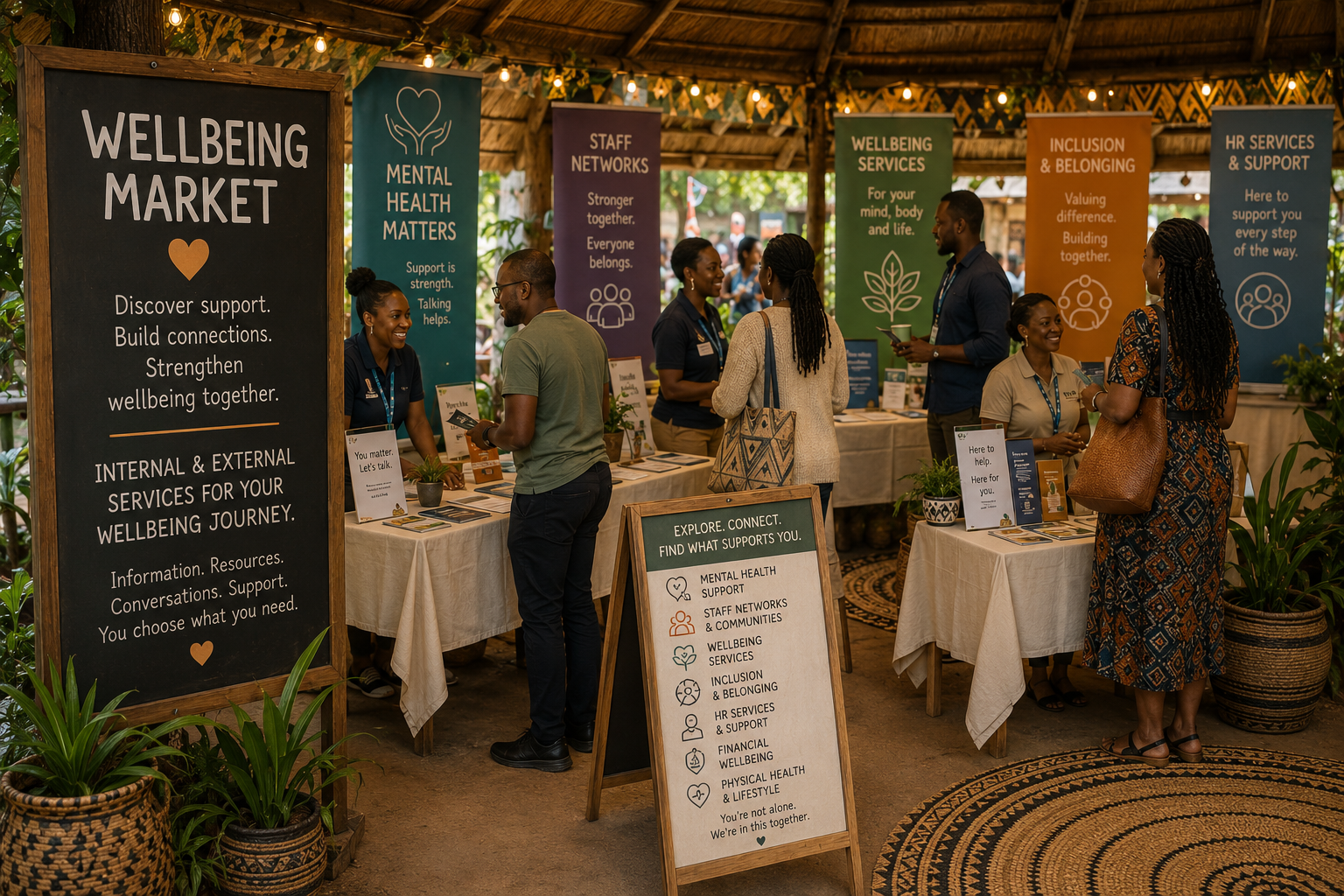
Making support visible, relational and reachable.
The Wellbeing Market brings people into closer relationship with support.
Participants may encounter internal and external services, specialist knowledge, community resources and practical pathways towards help.
They can explore what support exists, what a first step might involve and what can make asking for help feel more human.
The Market also helps clarify responsibility.
Colleagues are not expected to diagnose one another. Managers are not asked to become counsellors. Organisations cannot transfer responsibility for difficult working conditions onto individual resilience.
But people can learn to listen without judgement, respond without taking over and make appropriate support easier to reach.
Just-a-Moment Lounge.
*
Just-a-Moment Lounge. *
The Just-a-Moment Lounge remains accessible throughout every Wellbeing Walk.
It is not another stage in the developmental sequence.
It is a place to pause.
To breathe.
To replenish.
To seek support.
Or simply to have a moment without needing to explain why.
Participants do not need permission to step away, and using the Lounge does not label somebody as distressed or unable to participate.
Care is not positioned beside the Festival.
Care is part of how the village has been built.
A Constant Centre of Care
*
A Constant Centre of Care *
Where the Walks Diverge.
After the Wellbeing Market, the three Walks begin to travel differently.
Tanga journeys towards renewed recognition through the Humanity Wall.
Batanai and Raramai continue through the Community Kitchen, before Batanai journeys towards the Ripple Tree and Raramai towards the Drumming Circle.
The village is shared.
The developmental invitation changes.
Tanga Wellbeing Walk.
Conscious Recognition and Connection
Tanga—means begin.
Who am I, really?
Tanga begins with the person.
It invites participants to encounter themselves beyond role, performance and expectation—and to consider the stories, relationships, terrain and support shaping their wellbeing.
Its complete route is:
Mauya Conversation Café → Story Hut → Village Bicycle Stoep → Wellbeing Market → Humanity Wall → Mauya
Tanga creates conditions in which people may see themselves, their journeys, the support surrounding them and one another differently.
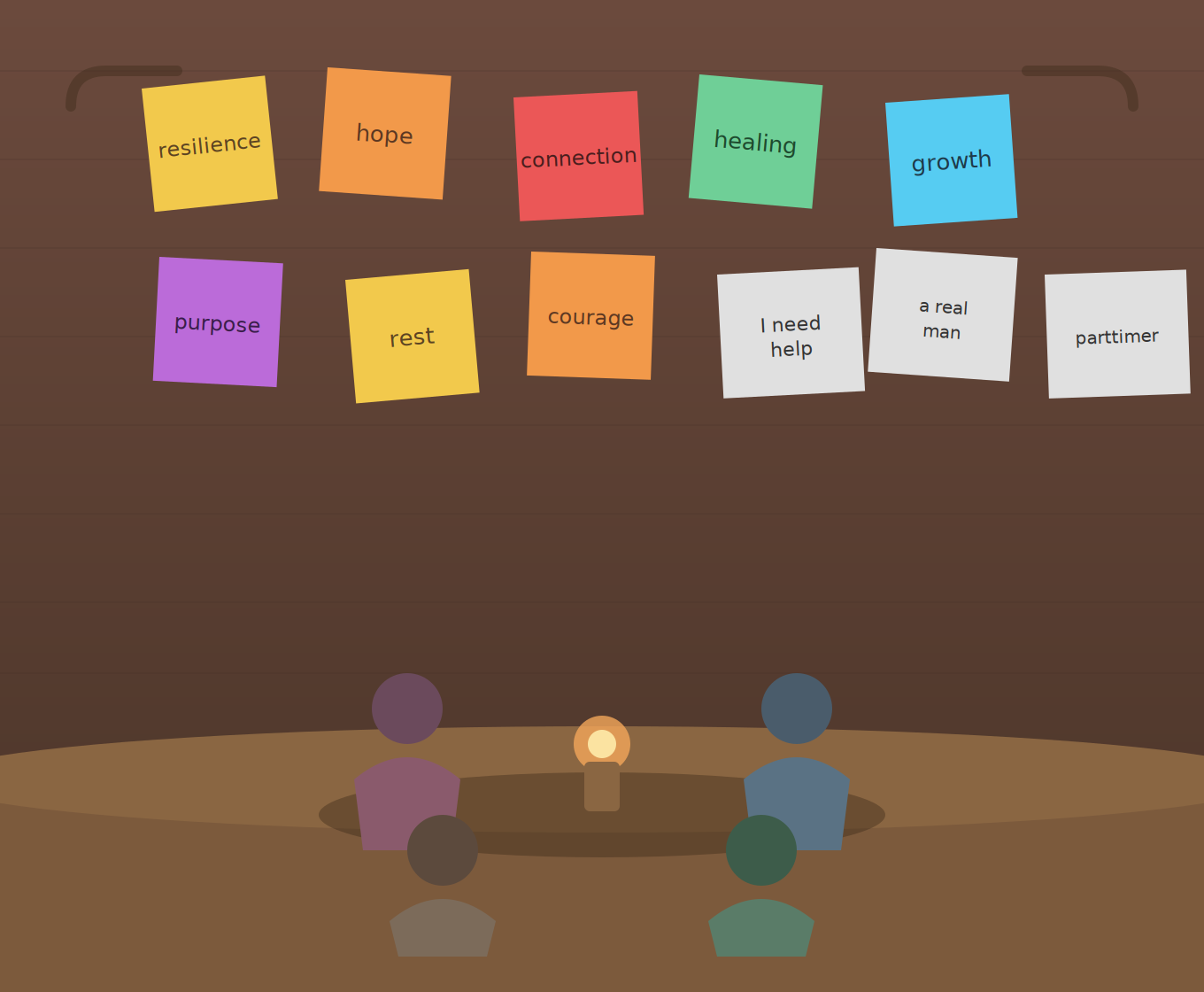
Humanity Wall.
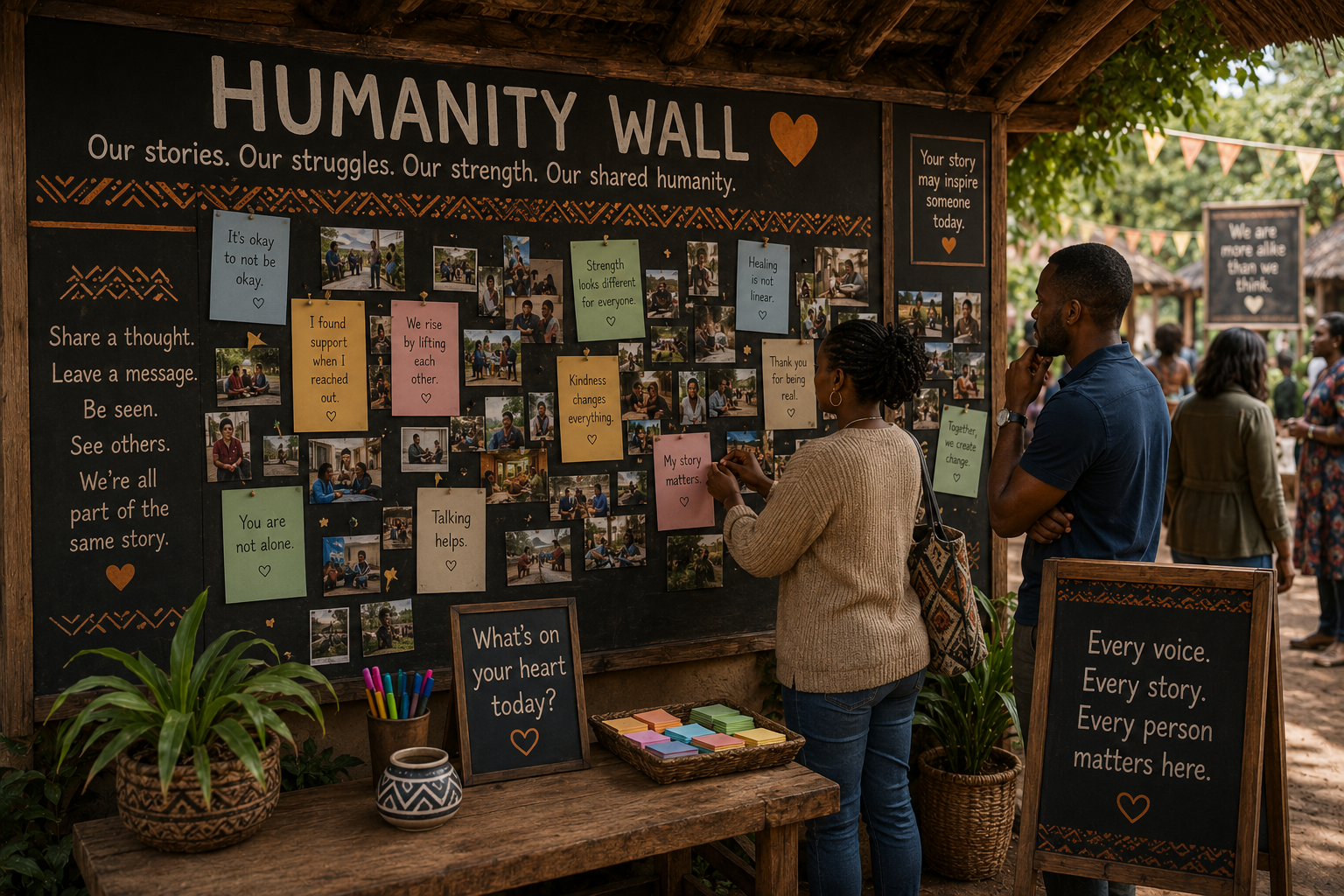
The Humanity Wall brings Tanga towards renewed recognition.
It invites participants to consider who they are beneath the roles through which organisations and other people may usually encounter them.
A person carrying stories.
A rider travelling through real terrain.
A human being investing finite Wellbeing Tokens.
Someone who may offer support.
Someone who may need it.
Batanai Wellbeing Walk.
Shared Participation and Contribution.
Batanai—means come together.
Who can we become together, truly?
Batanai begins with the person and carries recognition into relationship.
It explores belonging, contribution, interdependence and the ways people nourish—or deplete—themselves and the communities they share.
The individual does not disappear into the group.
Difference is not treated as a barrier to community, and agreement is not required as proof of connection.
Its complete route is:
Mauya Conversation Café → Story Hut → Village Bicycle Stoep → Wellbeing Market → Community Kitchen → Ripple Tree → Mauya
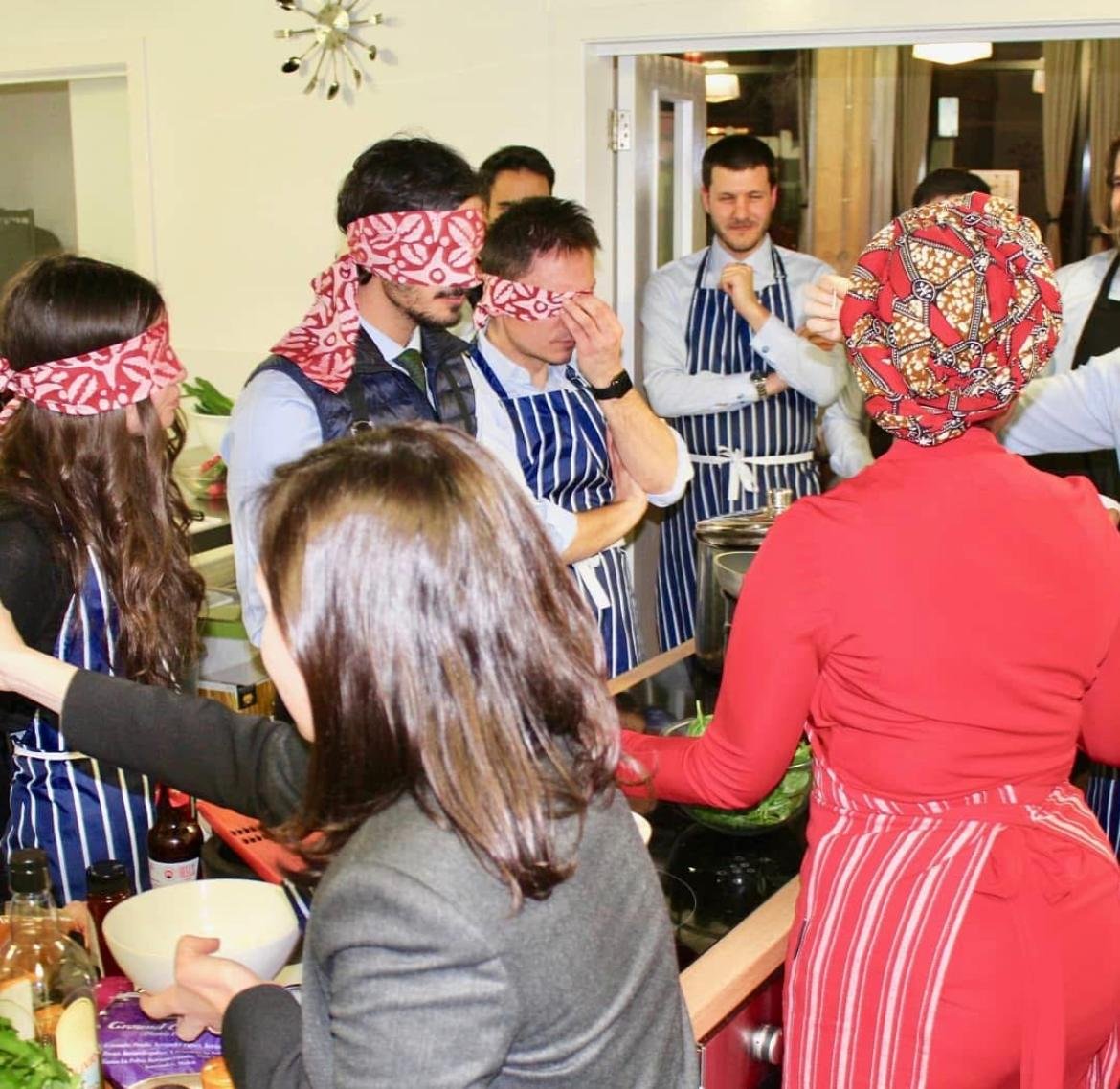
Community Kitchen
Community Kitchen
What Fuels Our Wellbeing?
The Community Kitchen invites people to explore an everyday dimension of wellbeing that can easily be overlooked: how we nourish and fuel ourselves.
Through food, conversation and shared experience, participants are invited to become curious about the relationship between nutrition, energy, mood, concentration, recovery and sustainable performance.
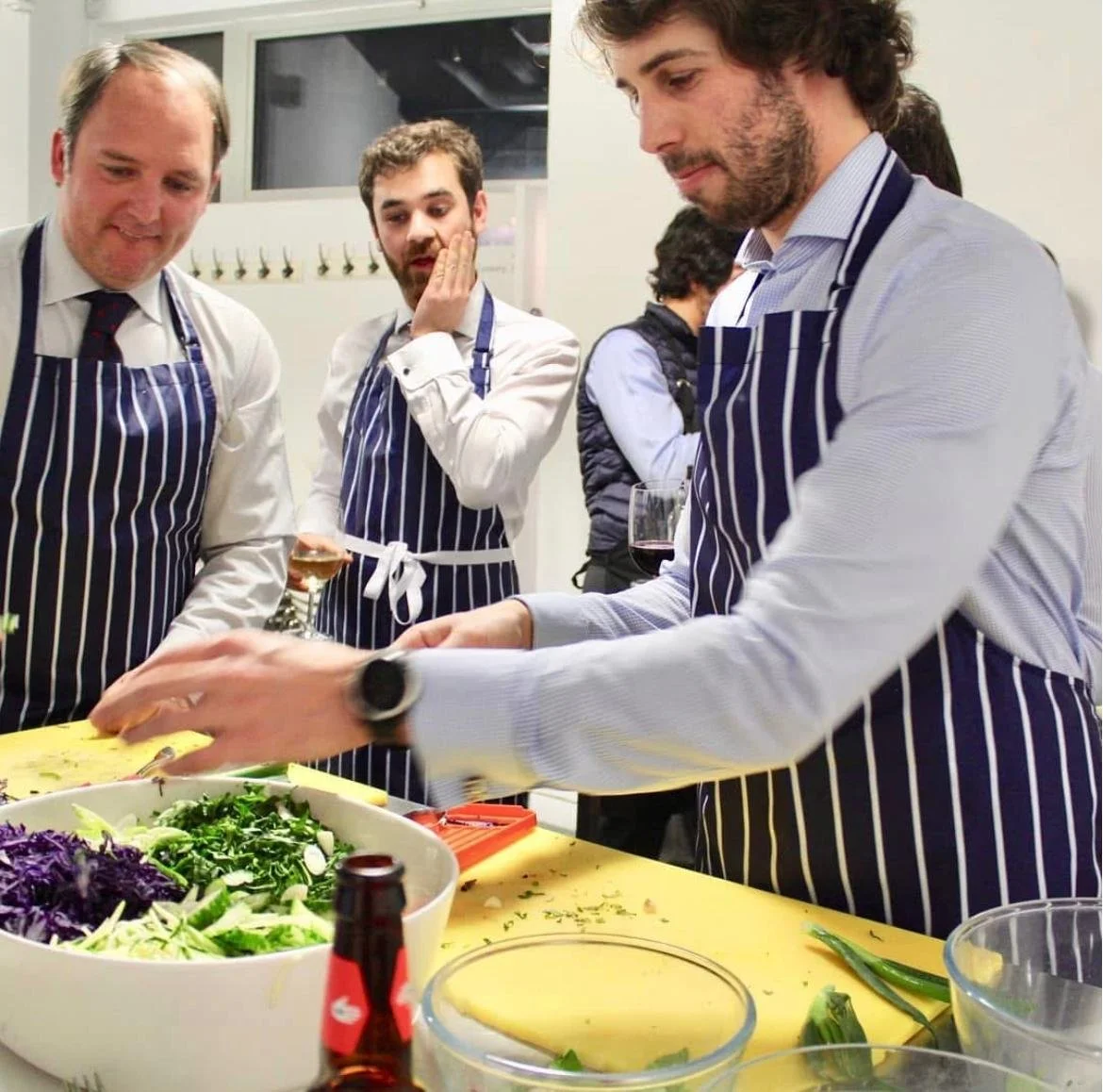
Rather than prescribing what people should eat, the Kitchen creates space to explore what helps each of us feel nourished and able to bring our energy to the things that matter.
The Kitchen creates space to consider:
What helps fuel our wellbeing?
What do we notice about the relationship between what we eat and how we feel, think and perform?
What happens to our energy when the demands of work leave little time to pause, eat or replenish?
What helps us make nourishing choices — and what can make those choices difficult?
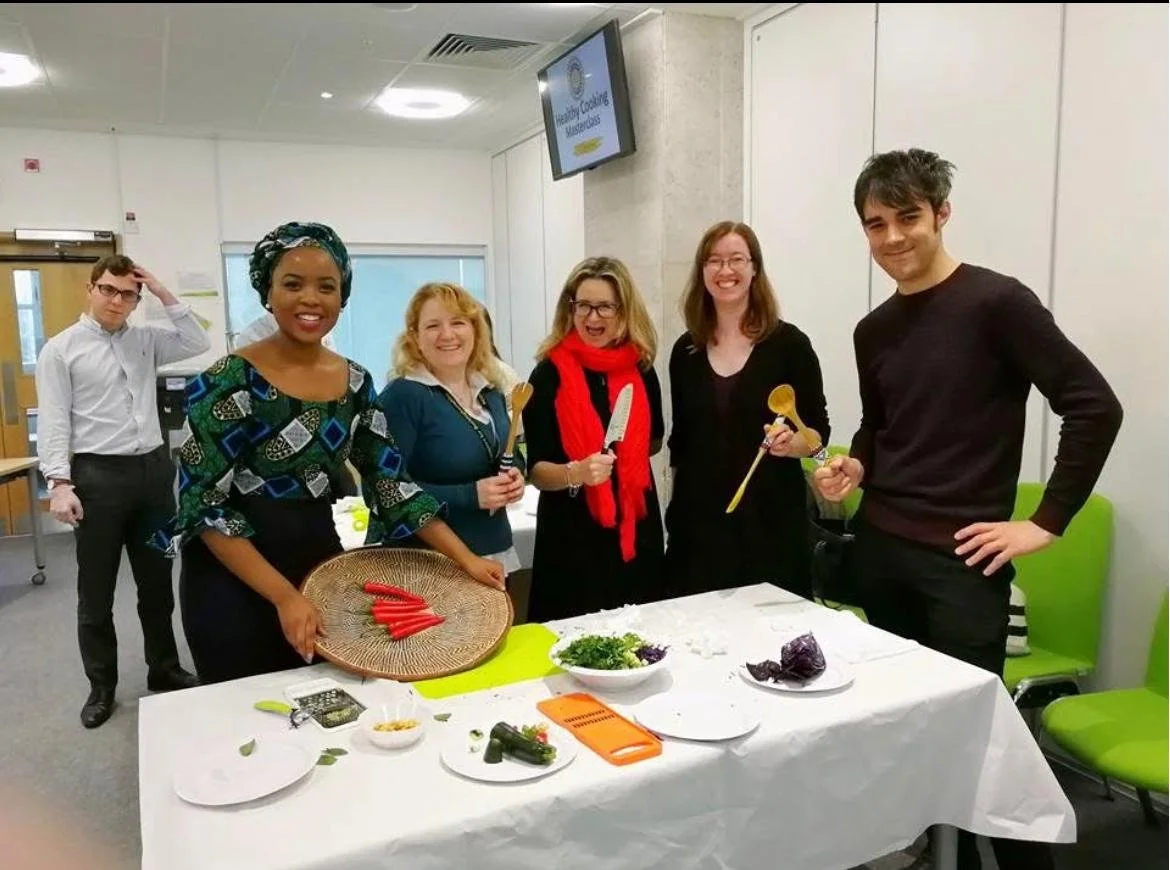
What conditions might help people nourish themselves well at work?
Nutrition is personal, but it does not exist outside the conditions in which people live and work.
Time, shift patterns, workload, breaks, access to nourishing food and workplace culture can all influence the choices available to people.
The Community Kitchen invites us to explore wellbeing together — not only through what is on our minds, but also through what fuels our bodies. It invites us to consider how we replenish our energy tokens, becoming curious about the difference between quick energy and sustained nourishment.
Ripple Tree.
From recognition to possibility.
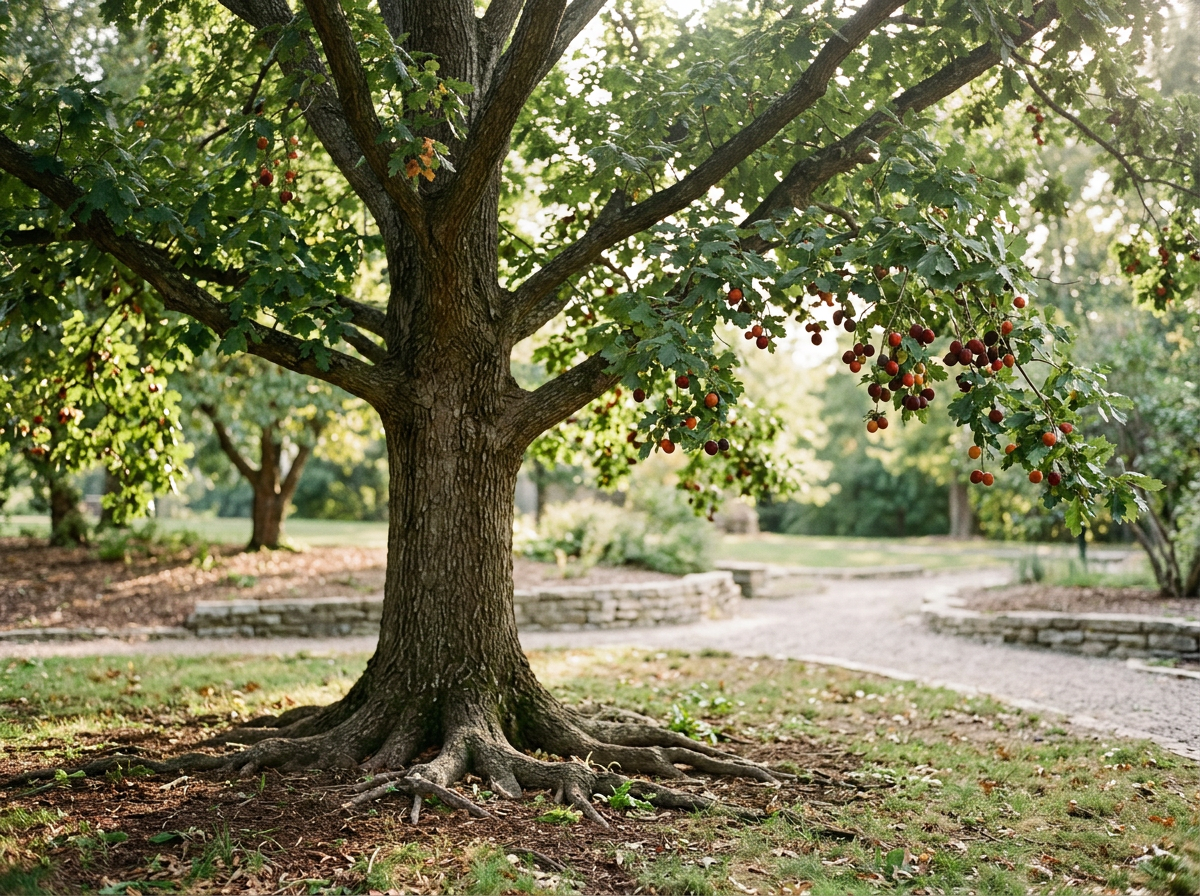
The Ripple Tree is Batanai's culminating Place.
Its roots begin with recognised humanity. Its ground is formed through the conditions that help people feel that they belong. Its branches reach towards shared possibility.
Participants may consider what they would value receiving within the communities they share—and what contribution they may freely choose to make.
The Tree does not turn possibility into a compulsory commitment.
It recognises that influence, authority and accountability are differently distributed while inviting everyone to notice that their presence and choices can create ripples.
Batanai helps personal recognition travel into the ways people encounter, support and make room for one another.
Raramai Wellbeing Walk:
Embodied Practice and Sustained Be(coming).
Raramai—means live or be alive.
What can we begin to practise, embody and sustain together?
Raramai brings recognition and shared possibility into lived practice.
Participants travel through the village with questions oriented towards everyday experience.
They explore what happens when intention encounters real relationships, organisational pressures, disproportionate power dynamics, uneven terrain and the need for sustained support.
Its complete Festival route is:
Mauya Conversation Café → Story Hut → Village Bicycle Stoep → Wellbeing Market → Community Kitchen → Drumming Circle → Mauya
Raramai shares the Community Kitchen with Batanai, but carries its questions onwards towards practice and embodiment.
Drumming Circle.
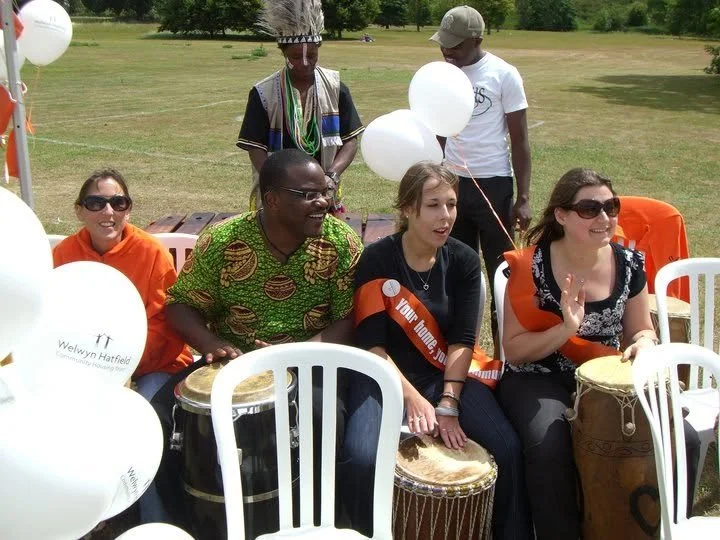
The Drumming Circle invites participants to encounter interdependence through rhythm, listening, contribution, difference and shared movement.
No single participant owns the rhythm.
Some may lead for a time. Others may listen, support or respond.
The quality of what emerges depends not upon everybody becoming identical, but upon people learning how their distinct contributions relate.
Listening. Contributing. Moving together.
The Circle creates an embodied encounter with questions that cannot always be understood through discussion alone:
How do we listen while contributing?
How do power and presence affect the shared rhythm?
What happens when somebody cannot hear— or is not being heard?
What can we begin to practise, embody and sustain together?
Raramai does not require immediate mastery.
It provides room to attempt, notice, reflect and learn.
Raramai: Beyond the Festival Day.
The Raramai Wellbeing Walk is complete when participants return to Mauya.
Where people and the organisation wish to carry emerging learning into everyday practice, opportunities for continued reflection and coaching may create a bridge between Festival insight and lived organisational experience.
Any continuation remains a distinct invitation rather than an assumed next step.
Every Walk Returns to Mauya.
*
Every Walk Returns to Mauya. *
The Return Matters.
Participants are not sent directly from a meaningful personal, relational or embodied encounter back into organisational life without closure, replenishment or an opportunity to seek support.
Mauya receives them again without inspection.
Participants may share what has stayed with them, reflect privately, ask a further question or simply receive hospitality before travelling onwards.
Every Wellbeing Walk is complete.
Every person's Journey of Be(coming) remains open.
And the village offers one final invitation:
Fambai zvakanaka. Travel well.
The Care that Holds the Festival Together.
Care does not sit beside the Festival. It is an integral part of it’s design.
The Festival's warmth is supported by responsible design and stewardship.
Participants may speak, listen, observe, contribute in another way, pause, seek support or decline an invitation they are not ready to receive.
Nobody is required to disclose personal experience, perform vulnerability or travel beyond their capacity in order to belong.
Care is supported through clear expectations around choice, consent and privacy; the constant availability of Just-a-Moment; visible Journey Companions; appropriate pathways towards specialist support; and responsible safeguarding and referral arrangements.
Personal stories are not treated as organisational evidence simply because they have been shared within the Festival.
Where learning is carried back into organisational conversation, participant dignity, privacy and informed consent remain central to how that learning is stewarded.
An Experiential Doorway into Systemic Wellbeing.
The Ubuntu Wellbeing Festival can stand as a complete developmental experience in its own right.
It may also open or contribute to a wider exploration of the conditions shaping wellbeing across organisational life.
What the Festival makes visible does not predetermine what should happen next.
It creates another opportunity to listen.
Where Might Your Ubuntu Wellbeing Festival Walk Begin?
Mauya. Welcome. As You Are.
You may already recognise something within Tanga, Batanai or Raramai that speaks to your people and organisation.
Or you may simply be wondering whether a different kind of wellbeing experience could create space for conversations, relationships and possibilities that existing approaches have struggled to reach.
You do not need to arrive knowing which Walk is right.
A Possibility Conversation creates space to explore what you are noticing, what you hope might become possible and whether the Ubuntu Wellbeing Festival could responsibly meet the terrain you and your people are travelling.